Supporting modern insurance and healthcare benefits programs for Indian employees at scale
This project was done as part of contributions towards building HealthFlex, Loophealth’s new-age benefits vertical that I helped build from ground up with the team.
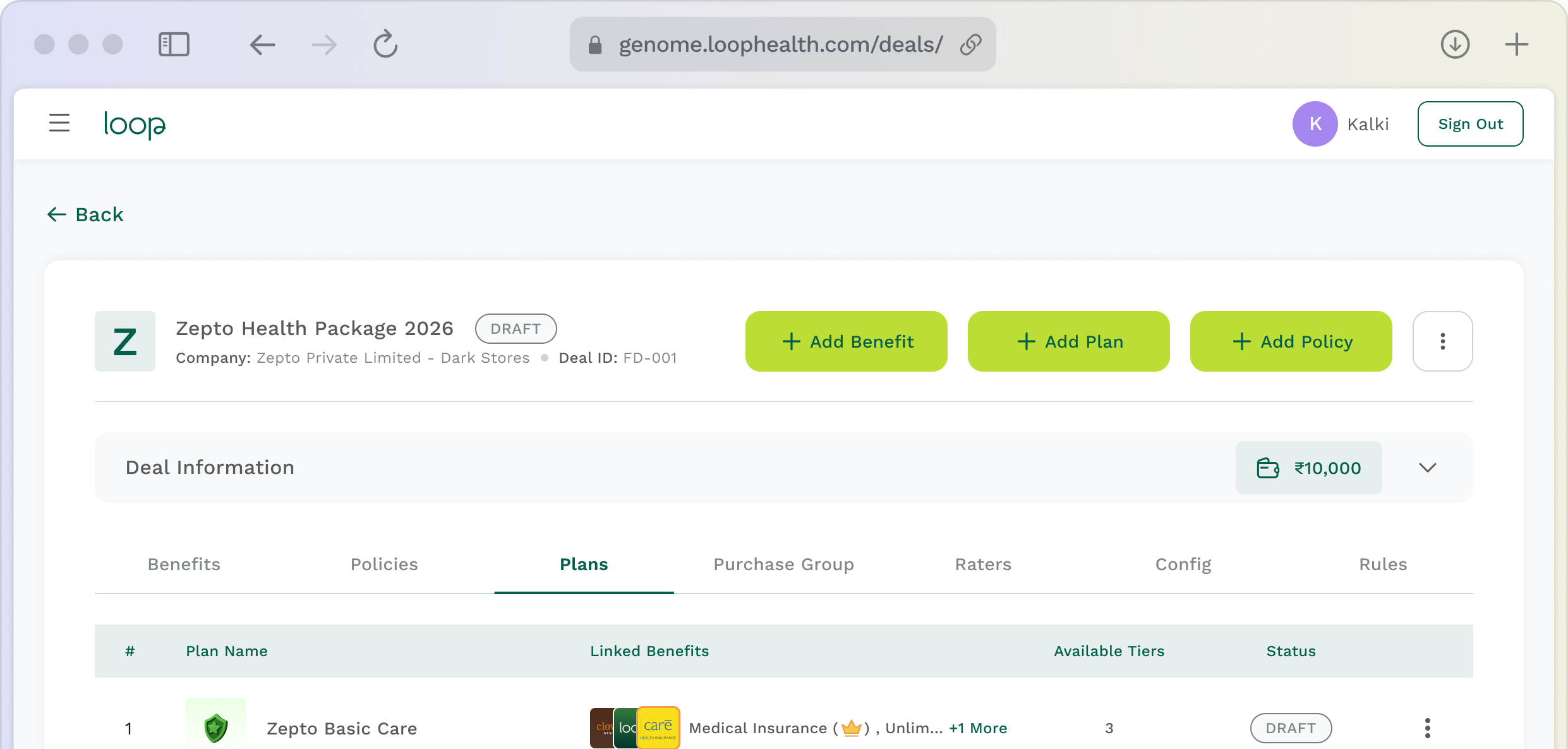
The case study showcases a major overhaul of our systems and the downstream products, moving from a policy based world to a broader benefits based world. Specifically focussing on two major modules:
Getting things fast, accurate and accessible meant everything — HR trust, Employees having a confident and great enrolment experience, and, to a degree, chances of retaining the client.
I was an IC+manager on this project along with another product designer; responsible for problem definition, execution, planning, alignment and the final deliverables.
Other core team members were 2 PMs, 6-8 devs. We tested with and actively involved 1 product success specialist and multiple agents at key points in the process.
By the time we had some depth and breadth of companies serviced, the limitations of building on top of policy-first legacy systems started showing drastically. It served us well the first year, allowed us speed and agility. We were encountering:
“How might we empower operators and agent to rapidly configure and deploy complex corporate benefit structures with near-zero error rates, seamless post-launch edit-ability, and virtually zero engineering dependency, while providing employees with the correct information”
The deep-dive into systems research, deal-based architecture, and final product flows is password-protected. Reach out to kalki.kaul@gmail.com if you need access.
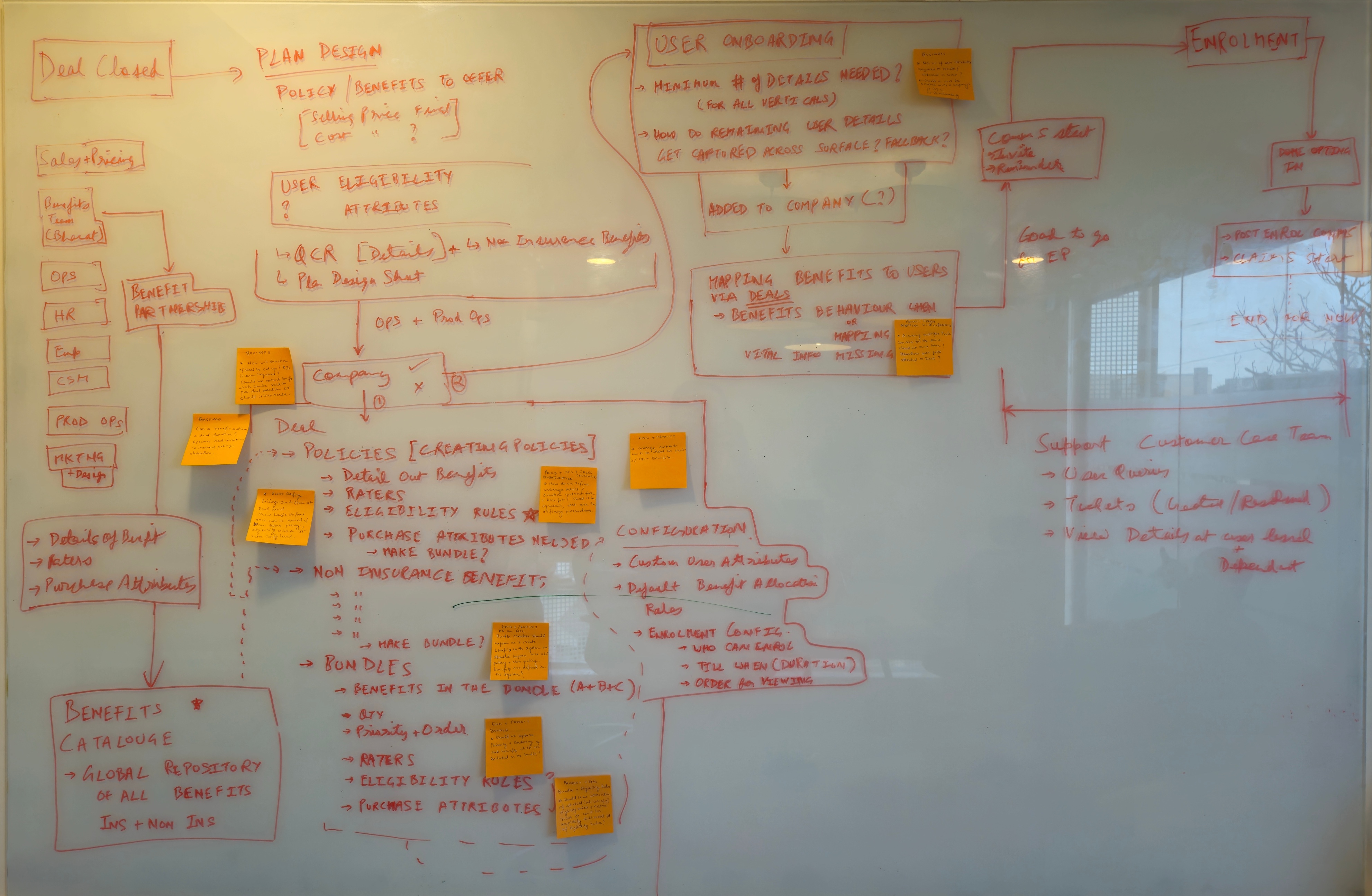
One of the early activities I did with the team was to map out all the moving pieces that we knew at the time, and placing them along key phases in our user journey:
As we synthesized the whiteboard mapping and deep-dived into operational edge cases, a fundamental shift became apparent: moving away from an inflexible policy-first container where all benefits had to be shoehorned under an insurance contract, to a scalable deal-based architecture with first-class decoupled entities.
How the mental models transformed: from insurance policies acting as the sole structural container to a modular, decoupled benefits architecture.
Insurance policies served as the rigid root container. Every employee health or wellness benefit had to be forced inside an underwriter policy contract.
The single legal account registered on Loop. Lacked multi-entity corporate group hierarchy.
The underwriter insurance contract (GMC, Life, Accident). All OPD, wellness, and consultations were forced into this policy, creating tight coupling and manual maintenance.
A modular hierarchy separating the commercial agreement, employee segments, benefit packages, and fulfillment contracts into first-class decoupled entities.
The holding enterprise umbrella that can house multiple distinct companies or subsidiaries under shared billing and governance.
The operational business entity (e.g. Company 1, Company 2) employing staff and signing benefit deals.
The central root container defining annual flex budgets, enrolment timelines, pricing, and contract agreements.
Target audience segment (e.g., leadership, full-time employees, contractors) mapped to specific benefit entitlements.
A curated package combining multiple benefits (e.g. GMC + OPD + Dental) presented as a coherent choice during enrolment.
First-class citizen in the system. Can be insurance-backed (GMC, Life) or standalone non-insurance (Wellness, OPD, mental health).
Demoted from master wrapper to a downstream fulfillment layer. Only attached when a benefit is backed by an insurance underwriter; wellness requires no policy.